Key Things to Remember from “The Elements of Style” by Strunk and White
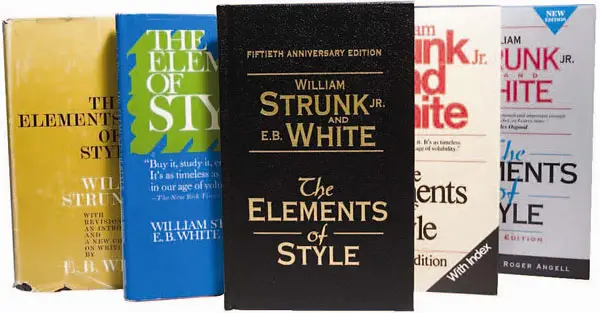
This article is based off the book The Elements of Style, which is a timeless guide to writing with clarity and precision. This article summarizes key principles from the book, focusing on rules and reminders that enhance the quality and effectiveness of your writing. From essential grammar and usage rules to tips on developing a unique yet clear style, these insights offer practical advice for writers at all levels.
1. Elementary Rules of Usage
The fundamental writing rules for proper grammar and punctuation usage.
Form the Possessive Singular by Adding ‘s:
- Example: Charles’s friend, the witch’s malice.
- Clarification: Use ‘s to show that something belongs to someone or something. Exceptions include ancient names like Moses’ laws and phrases like “for conscience’ sake”. Pronouns like hers, its, theirs don’t use an apostrophe.
Use Commas in a Series:
- Example: Red, white, and blue.
- Clarification: This is known as the “serial” comma. Use it before “and” or “or” in lists. Business names may omit the final comma (e.g., Little, Brown and Company).
Enclose Parenthetic Expressions with Commas:
- Example: The best way to see a country, unless you are pressed for time, is to travel on foot.
- Clarification: Use commas to set off extra information that isn’t essential to the main point. If removing the extra information doesn’t change the sentence’s meaning, use commas.
Use a Comma Before a Conjunction in a Compound Sentence:
- Example: The situation is perilous, but there is still one chance of escape.
- Clarification: When joining two complete sentences with conjunctions like and, but, or, nor, use a comma before the conjunction.
Do Not Join Independent Clauses with a Comma:
- Example: It is nearly half past five; we cannot reach town before dark.
- Clarification: Use a semicolon or a period to join two complete sentences. A comma isn’t strong enough on its own.
Do Not Break Sentences in Two:
- Incorrect: She was an interesting talker. A woman who had traveled all over the world.
- Correct: She was an interesting talker, a woman who had traveled all over the world.
- Clarification: Avoid splitting one complete thought into two sentences. Use a comma or other suitable punctuation to keep the thought together.
Use a Colon to Introduce a List or Quote:
- Example: He brought three things: a book, a pen, and paper.
- Clarification: Use a colon to introduce related items or to expand on a statement. The part before the colon should be a complete sentence.
Use a Dash for Abrupt Breaks or Summaries:
- Example: The sun rose — a glorious sight.
- Clarification: A dash is used for sudden breaks in thought or to add emphasis. It’s less formal than a colon but more noticeable than a comma.
Subject-Verb Agreement:
- Example: The flavor of the cakes is delicious.
- Clarification: Make sure the verb matches the subject in number (singular or plural), even if other words come between them.
Use the Proper Case of Pronouns:
- Example: She gave it to him and me.
- Clarification: Pronouns change form based on their role in the sentence (subject, object, possessive). “Its” shows possession, while “it’s” means “it is.”
Participial Phrases Must Refer to the Subject:
- Incorrect: Walking down the street, the trees were beautiful.
- Correct: Walking down the street, I found the trees beautiful.
- Clarification: The introductory phrase should clearly refer to the main subject of the sentence. If not, it creates confusion.
2. Elementary Principles of Composition
Guidelines for organizing and structuring your writing effectively.
Choose a Suitable Design and Hold to It
- Description: Plan your writing before you start. A clear structure helps keep your writing focused and coherent. Even if you deviate from the plan, having a basic outline will guide your writing.
- Clarification: Think of it like building a house. You need a blueprint before you start, even if some changes happen along the way.
Make the Paragraph the Unit of Composition
- Description: Each paragraph should cover one main idea. Use paragraphs to organize your thoughts and make your writing easier to read.
- Clarification: Like chapters in a book, paragraphs break down your writing into manageable pieces. This helps readers follow your argument or story.
Use the Active Voice
- Description: The active voice makes your writing direct and vigorous. It usually involves a subject performing an action (e.g., “The cat chased the mouse” vs. “The mouse was chased by the cat”).
- Clarification: Active voice energizes your writing and makes it clear who is doing what.
Put Statements in Positive Form
- Description: State things in a positive manner rather than negative (e.g., “She is honest” instead of “She is not dishonest”).
- Clarification: Positive statements are clearer and more direct. They make your writing stronger and more assertive.
Use Definite, Specific, Concrete Language
- Description: Use specific details and concrete terms to make your writing clear and vivid (e.g., “He grinned as he pocketed the coin” vs. “He showed satisfaction as he took possession of his well-earned reward”).
- Clarification: Concrete details paint a clear picture and make your writing more engaging.
Omit Needless Words
- Description: Make your writing concise by removing unnecessary words (e.g., “He is a man who is honest” becomes “He is honest”).
- Clarification: Less is more. Clear, concise writing is more powerful and easier to read.
Avoid a Succession of Loose Sentences
- Description: Vary your sentence structure to avoid monotony. Too many loose sentences (connected by “and,” “but,” “or”) can make your writing seem lazy or repetitive.
- Clarification: Mixing up sentence structures keeps your writing interesting and dynamic.
Express Coordinate Ideas in Similar Form
- Description: Use parallel construction for ideas of equal importance (e.g., “He likes swimming, running, and biking” instead of “He likes swimming, to run, and biking”).
- Clarification: Parallel structure improves readability and flow, making your writing easier to follow.
Keep Related Words Together
- Description: Place words and phrases that are related close together in a sentence (e.g., “He noticed a large stain in the rug that was right in the center” vs. “He noticed a large stain right in the center of the rug”).
- Clarification: Keeping related words together helps prevent confusion and makes your writing clearer.
In Summaries, Keep to One Tense
- Description: Use the same tense throughout a summary to maintain consistency. Usually, the present tense is used for summaries.
- Clarification: Consistent tense helps your writing stay clear and logical.
Place the Emphatic Words of a Sentence at the End
- Description: The most important words should usually be at the end of the sentence for emphasis (e.g., “Because of its hardness, this steel is used principally for making razors”).
- Clarification: Ending with key information leaves a strong impression and highlights the main point.

3. Form
Standards for formatting and presenting written work professionally.
Colloquialisms
- Description: Use colloquial expressions or slang naturally, without quotation marks.
- Clarification: Quotation marks can make your writing seem pretentious, as if you’re emphasizing that you know the term is informal.
Exclamations
- Description: Reserve exclamation marks for true exclamations or commands, not for simple statements.
- Clarification: Using exclamation marks too often can make them lose their impact.
Headings
- Description: Leave space at the top of page 1 for editor’s notes. Place the heading or title a fourth of the way down the page, and don’t use a period after a title.
- Clarification: Proper spacing and formatting of headings make your manuscript more professional.
Hyphen
- Description: Use hyphens for compound adjectives (e.g., “leisure-class pursuits”) but avoid them in words that are commonly written as one (e.g., “wildlife” instead of “wild-life”).
- Clarification: Hyphens can change the meaning of phrases and should be used carefully to ensure clarity.
Margins
- Description: Keep right and left margins roughly the same width. Leave more space on the left if annotating or editing is expected.
- Clarification: Consistent margins make your document look neat and professional.
Numerals
- Description: Use figures for dates and serial numbers (e.g., “August 9, 1988”). Spell them out in dialogue.
- Clarification: Using figures is standard in most writing, but spelling them out in dialogue can make it feel more natural.
Parentheses
- Description: Punctuate sentences with parentheses as if the parenthetical expression were absent.
- Clarification: Proper punctuation around parentheses keeps sentences clear and readable.
Quotations
- Description: Use quotation marks for formal quotations and direct speech. Place commas and periods inside the quotation marks.
- Clarification: Proper punctuation of quotations helps clarify who is speaking and what is being quoted.
References
- Description: Abbreviate frequently occurring titles in scholarly work and give full forms in a list at the end.
- Clarification: Clear referencing ensures your sources are easily identifiable and traceable.
Syllabication
- Description: Consult a dictionary to divide words correctly at the end of a line.
- Clarification: Proper word division prevents misreading and maintains the flow of your text.
Titles
- Description: Use italics for the titles of literary works. Omit initial articles (A, The) when placing a possessive before them.
- Clarification: Consistent formatting of titles makes your writing look polished and professional.
4. An Approach To Style
Advice on developing a distinctive and clear writing style.
Place Yourself in the Background
- Description: Write in a way that highlights your message, not yourself. Let your personality emerge naturally through your writing.
- Clarification: Focus on clarity and substance. Your style will develop as you refine your use of language.
Write in a Way that Comes Naturally
- Description: Use words and phrases that come easily to you. Don’t worry about imitating others; your unique voice will come through.
- Clarification: Authenticity is key. Write as you speak, but refine your language to enhance readability and impact.
Work from a Suitable Design
- Description: Plan your writing. Whether it’s a detailed outline or a rough sketch, having a structure helps organize your thoughts.
- Clarification: Even spontaneous writing benefits from a basic plan. Knowing your direction keeps your writing focused.
Write with Nouns and Verbs
- Description: Use strong nouns and verbs instead of relying on adjectives and adverbs.
- Clarification: Nouns and verbs carry the weight of your writing. Adjectives and adverbs should enhance, not carry, your sentences.
Revise and Rewrite
- Description: Writing is rewriting. Don’t expect perfection on the first try. Revise to improve clarity, coherence, and style.
- Clarification: Editing is a crucial part of writing. Be willing to make significant changes to enhance your work.
Do Not Overwrite
- Description: Avoid overly complex and ornate prose. Simple, clear language is more effective.
- Clarification: Less is often more. Focus on clarity and conciseness to make your writing more impactful.
Do Not Overstate
- Description: Exaggeration can undermine your credibility. Be accurate and measured in your statements.
- Clarification: Overstatement can make readers skeptical. Be honest and precise to maintain trust.
Avoid the Use of Qualifiers
- Description: Words like “very,” “rather,” and “quite” weaken your writing. Use strong, definitive language.
- Clarification: Qualifiers dilute your message. Be confident and direct in your statements.
Do Not Affect a Breezy Manner
- Description: Avoid writing that feels overly casual or self-indulgent. Focus on delivering your message clearly.
- Clarification: Breeziness can come across as insincere. Maintain a balance between casual and formal.
Use Orthodox Spelling
- Description: Stick to standard spelling. Avoid using simplified or phonetic spellings.
- Clarification: Consistency in spelling helps maintain professionalism and clarity.
Do Not Explain Too Much
- Description: Let your writing speak for itself. Avoid overusing adverbs or explanatory phrases.
- Clarification: Trust your readers to understand your message. Excessive explanation can be distracting.
Do Not Construct Awkward Adverbs
- Description: Avoid creating clumsy or uncommon adverbs. Use more straightforward language.
- Clarification: Simple language is often more effective. Avoid adding unnecessary complexity.
Make Sure the Reader Knows Who is Speaking
- Description: Clearly attribute dialogue to avoid confusion.
- Clarification: Proper attribution ensures your dialogue is easy to follow and understand.
Avoid Fancy Words
- Description: Use simple, clear language. Avoid using complex or pretentious words when simpler ones will do.
- Clarification: Simplicity enhances readability. Choose words that are clear and direct.
Do Not Use Dialect Unless Your Ear is Good
- Description: Only use dialect if you are confident in your ability to reproduce it accurately and consistently.
- Clarification: Inconsistent or inaccurate dialect can confuse readers. Use standard language unless you’re sure of your dialect.
Be Clear
- Description: Clarity is crucial in writing. Make sure your sentences are easy to understand.
- Clarification: Clear writing effectively communicates your message. Avoid ambiguity and complex constructions.
Do Not Inject Opinion
- Description: Keep your personal opinions separate unless they are relevant and necessary.
- Clarification: Unsolicited opinions can distract from your main message. Focus on the topic at hand.
Use Figures of Speech Sparingly
- Description: Metaphors and similes should enhance your writing, not overwhelm it.
- Clarification: Too many figures of speech can confuse readers. Use them wisely to add clarity and interest.
Do Not Take Shortcuts at the Cost of Clarity
- Description: Avoid abbreviations and shortcuts that might confuse readers. Spell things out clearly.
- Clarification: Clear, detailed writing is more effective than cryptic shorthand. Ensure your message is easily understood.
Avoid Foreign Languages
- Description: Use English unless a foreign term is widely known and necessary.
- Clarification: Foreign terms can alienate readers. Stick to English for clarity.
Prefer the Standard to the Offbeat
- Description: Use conventional language and structures. Avoid unusual words or constructions unless necessary.
- Clarification: Standard language is more widely understood. Save unique expressions for when they add significant value.
For a deeper dive into these invaluable writing principles, explore The Elements of Style by Strunk and White.
This classic guide offers comprehensive insights and detailed explanations that will further enhance your writing skills and style. Whether you’re a novice writer or a seasoned professional, this book is an essential addition to your literary toolkit.
You can also explore all articles on famous writers here.
A short note
Each Sunday, I share a free email called The Creative Capsule featuring two carefully chosen works: one album and one film.
It’s short, ad-free, and designed to help you decide what to watch or listen to without scrolling.
 1 painting, album, film, and book recommendation every week.
 Download your free creative reset guide